Supreme Court

Supreme Court

Under the Constitution of India, the Supreme Court is the premier judicial court of the country. It is recognized as the highest constitutional court in the country. Additionally, the Supreme Court is also considered to be the most powerful public institution in India. It takes up appeals which are mainly against the decisions given by the High Courts of various states as well as other courts. The Supreme Court is responsible for protecting the fundamental rights of citizens. Its role is to resolve disputes amongst different government authorities, and also handle matters between the central government viz-a-viz state governments or state governments from two different states.

The Supreme Court is headed by the Chief Justice of India and can consist maximum of 30 other judges who are appointed by the President. The retirement age for Supreme Court judges is 65 years. To become a Supreme Court judge, an individual must be a citizen of India. They also must have been a Judge of a High Court or two or more such courts in succession for at least 5 years. Alternately, they could be an advocate of a High Court, or of two or more such courts in succession for a minimum period of 10 years or they must be a distinguished jurist in the opinion of the President.

The independent functioning of Supreme Court Judges is ensured by the Consitution of India. A judge can only be removed from their position if an order is passed by the President. An order of this nature can be passed only after an address in both houses of Parliament is approved by a majority of the members in that house and by a majority of minimum two-thirds of members present and voting. If approved, it is sent to the President in the same session for removal based on proven misbehavior and/or incapability to perform their role. Once a person has been appointed a Judge of the Supreme Court, they are not allowed to practice in any court of law or before any other authority in India.
Judiciary

Judiciary

The Indian Judiciary comprises courts that focus on interpreting the law and applying it. The main role of these courts is to give a ruling on cases. They do this by first determining the key facts and the applicable law for a case, and then applying the key facts to the applicable law.  The Constitution empowers the Judiciary to act as the guardian of the law. It is considered to be the watchdog of democracy.

The Indian judicial system inherited the British colonial legacy in the form of their common law system. The Supreme Court of India, the High Courts in various states, and Subordinate Courts at district, municipal, and village levels together form the Indian Judiciary.

Each court is headed by designated individuals. The Chief Justice of India is the highest authority for the Supreme Court of India, also referred to as the Apex Court of the country. In comparison, Chief Justice of States individuals are responsible for controlling and running High Courts in different states. The District & Sessions Judges are in charge of managing the District Courts, also referred to as Subordinate Courts.

At the level of the Union government, issues related to the proper functioning of the Judiciary are raised in front of the Parliament by the Ministry of Law & Justice. The ministry has full jurisdiction to handles the issues linked to any of the courts in India. It is also responsible for the appointment of Judges for both, the High Courts as well as the Supreme Court of India.

Parliament 2

Parliament

Parliament

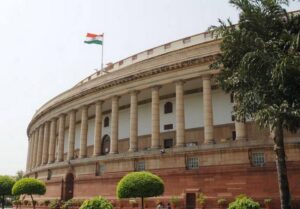
Parliament under the Union Government of India refers to the national legislature and consists of two houses making it a bicameral legislature. The Rajya Sabha (Council of States) and the Lok Sabha (House of the People) are the two houses in the Indian Parliament. The Parliament is considered to be the highest forum for debates in the country.

The Parliament is given the key power to discuss and enact changes, and make amendments to the Constitution of India. The process for enacting laws begins with the introduction of a bill in either of the two houses. A bill is a draft proposal, which needs to be passed in the Lok Sabha and Rajya Sabha, and only after the President gives his nod, it becomes an act. After the introduction of a Bill, the house may take it up for discussion or refer it to a Joint Committee/Select Committee to examine each clause and report back. In the next stage, the bill is put to a vote with the members present in the house, and based on the majority votes it is either rejected or passed.

Following is a list of key functions of the Parliament:

  1. Legislative Function: The role of the Parliament is to enact legislations. Even though it is the primary law-making body, very often the role of the Parliament is to simply vote and approve legislations. The role of drafting the bill is performed by the bureaucracy under the guidance of the concerned minister. 
  2. Control of Executive and ensuring its accountability: One of the most crucial functions of the Parliament is to ensure the Executive maintains its responsibility towards the people who have elected it and does not misuse its authority. 
  3. Electoral function: The Parliament performs its electoral function by electing the President and Vice President of India. 
  4. Judicial Function: The proposals for the removal of the President, Vice President, and Judges of the Supreme Court and High Court are deliberated and decided upon by the Parliament.